Wilderness and the American Mind Reflections
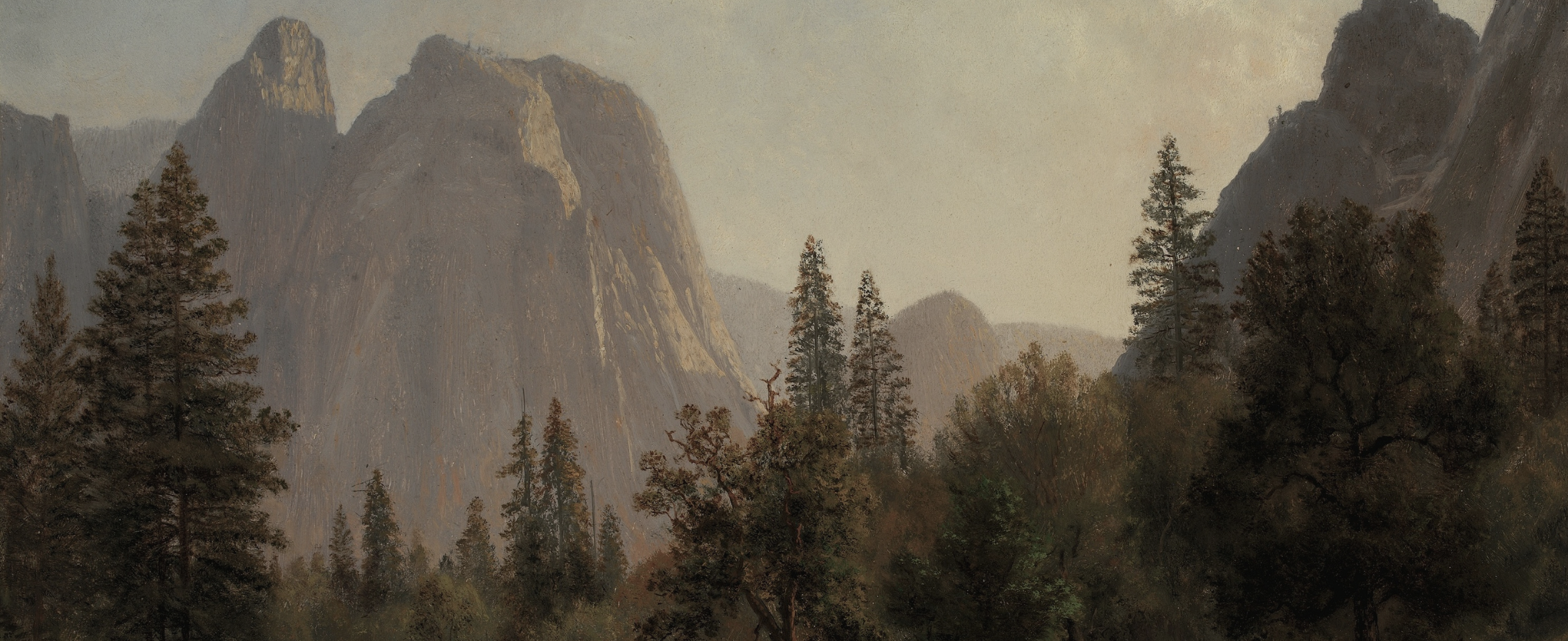
Albert Bierstadt. Cathedral Rocks, Yosemite Valley, ca. 1872. Smithsonian American Art Museum
Wilderness and the American Mind (1982)
By Roderick Nash
Summary:
An exploration of how attitudes toward wilderness have shifted throughout American history, and a study of the roots of environmental and conservation movements. Nash covers historical perspectives on wilderness, the idea of the wilderness as a 'wild second chance’ for the New World, and the development of preservation efforts in contrast to consumerist approaches.
Why This Book?
After reading a few books by Annie Dillard and Mary Oliver, books about nature have been on my mind. When I came across Wilderness and the American Mind in the miscellaneous stack at my local library, it seemed only natural to give it a try. After all, it only cost me a dollar. If the book was dull, poorly written, or lost my interest, I could donate it back to the library.
Expectations?
I was hopeful to find another book that touched on the topic of the natural world, but with the words “Third Edition” below the author’s name, I was prepared for an academic read, something a bit dry, and a helpful nightstand book that would help put me to sleep.
What I found was an immensely fascinating read. Instead of a tedious book on the condition of the wilderness or an agenda-laced manifesto intent on shame, Wilderness was wonderfully educational, and the writing captivating. Nash starts out with Old World views of the wilderness, then shifts the focus to the New World and its offers of a second chance at preservation. The book continues to help readers understand the backgrounds of great environmentalists like Aldo Leopold, Henry David Thoreau, and John Muir. There are also layers of historical and theological influences that have shaped today's views and perspectives on nature.
What stood out?
The different eras of romanticism, fear, and preservation caught my attention. I was intrigued by the way views of nature can shift depending on the powers that be and their intentions. How the wild parts of the country could go from beautiful evidence of creation to something that can be consumed. The information in this book helped me better understand how we got to where we are today.
The theological element to the conquering of nature was also a layer of interest. The use of Genesis 1:28 and the command to subdue the earth also made clear why people feel entitled to do what they like with the wilderness. Interpreted one way, the command is seen as caretaking, given that the male and female were given the role of caretaker of the garden. But after the fall of man, mankind took this command and twisted it to its ruthless nature. Suddenly, those who were made in God’s image were at war with God’s creation. This idea of subduing was also carried over to people groups, tribes, and cultures that white Protestants did not understand. People who lived off the earth were savages, and those with darker skin color were seen as beasts of burden. Completely wrong and at best, a manipulation of a Godly command. At its worst, some men (and women) decided they knew more or knew better than God and created a system of colonization and conquering not just of land, but of people.
The economic argument over whether the wilderness should be preserved or its resources used for an ever-growing population was also a point of interest. The chapter on Hetch Hetchy is a prime example of preservation of land as it is, or do the needs of people outweigh the needs of nature?
After I finished reading the book, I realized that some of my fatigue and weariness came from a lack of green space. Despite having a lush, nature-filled garden—more so than any other house on my street—I still needed more. Without camping or backpacking, I started searching for an untouched, unindustrialized patches of wilderness. I looked for such spaces both during travel and closer to home, where I could escape. I soon realized that the search for true wilderness would be more difficult than I expected.
“Thousands of tired, nerve-shaken, over-civilized people are beginning to find out that going to the mountains is going home; that wilderness is a necessity; and that mountain parks and reservations are useful not only as fountains of timber and irrigating rivers, but as fountains of life.”
First, I visited Buenos Aires and Montevideo in South America. I was grateful to see many green trees and parks even at the end of their summer, but amidst the city’s traffic, noise, and hustle, it was hard to feel like I was in nature. Later in the year, I went to the Smoky Mountains. I thought I would experience some wilderness and find peace. What I found was a place crowded with tourists, with trails running parallel to streets, and wildlife used to human presence. There was also concern about bears, and indeed, on the first afternoon, a black bear walked up to the balcony and then wandered away. I tried sitting outside near the front door the next morning, but everyone’s worry about animal encounters made the experience stressful, defeating the purpose of being outdoors alone.
Later in the summer, I visited Seattle and once again thought that the Pacific Northwest of my childhood would offer rest and renewal through nature. However, the purpose of the visit was to help my sister with a new baby, so going to the mountains wasn't feasible. Instead, we went to Carkeek Park, 10 minutes from Ballard. The patch of forest was refreshing. I was surrounded by tall cedar and hemlock trees at least a hundred feet high. The paths were shaded, and the shrubbery remained thick, a welcome feature of the Evergreen State. Yet, it still wasn’t enough. Even with the tall trees and view of the bay, there were roads, playgrounds, and houses nearby. The civilized world loomed inescapably all around.
It wasn’t until Labor Day that I experienced a true wilderness moment. My family and I visited Cleveland National Forest. Although it was hot and the air was dry, it was wonderful to escape the busyness and noise of civilization. One moment, deep along a trail, stood out. We found an open space where each of us could be alone and enjoy the quiet. My son played pretend pirate captain on a fallen tree, my daughter drew pictures of the scenery, my husband listened to music, and I journaled. Those ten minutes of solitude and silence were glorious. There were no planes, cars, or trains. No hum of electricity, appliances, or beeping vehicles. Only birds, trees, and me.
What was gained?
Besides adding ‘over-civilized' to my vocabulary, I also understood how mankind is connected to nature. From a biblical view, it makes sense that all of creation, plants, animals, land, and mankind were spoken into existence by the same voice. This alone establishes a sort of kinship. Another realization came from understanding the relationship between the wilderness and people. Each one of us needs nature, not to consume or subdue but to connect with.
In these “sanctuaries of reorientation,” we can “reduce life to the essentials of food and shelter.” From this perspective of dependency on the environment came a view of man “as part of the system of nature, not demigods above or outside it.”
Our souls need nature. We need to be around the uncontrolled and the wild to foster independence and confidence. I learned about “grounding” and ‘earthing” a while ago. Grounding is a mindful connection with the earth, such as placing hands on a mat in a yoga class. Earthing is direct physical contact with Earth’s surface, e.g., not using gloves when gardening or walking barefoot on grass. Both are ways to remember to reconnect with the natural world.
I was deeply moved by the idea of man’s kinship with nature, the thought that instead of nature being adverse to humankind, we actually need each other. From the soil man was created, and he returns to the depths of the earth when he dies. Much of our health depends on the functioning of the natural world. Yet across civilized and industrialized regions, many obstacles stand in the way of this connection. The word ‘kinship,' which signifies not just a connection but familial bonds, inspired the name of my blog. Humanity’s connection to nature and each other is the foundation of what I want to write about. Wilderness, which I discovered at a library sale, has guided me on a journey of inspiration, learning, awareness, and creation and I gained far more than I expected.
“Wild country has the power to remind civilized people that out there is a different world, older, greater, and deeper by far than ours, a world which surrounds and sustains the little world of men.”
Besides gaining some footing on understanding my struggle with over-civilization, the lack of wild places, and the need to better connect with nature, I also discovered numerous writers who touch on different aspects of the natural world. My reading list expanded with names like Edward Abbey, Wallace Stegner, John McPhee, Gretel Ehrlich, Gary Snyder, and many more. If interested in nature writing I highly recommend reading Wilderness and the American Mind. Also take a look at the following list of reading resources that expand on our connection with the natural world.
What are your thoughts on the kinship between humanity and nature? What books on nature have had an impact on you and/or reshaped your view of the natural world?